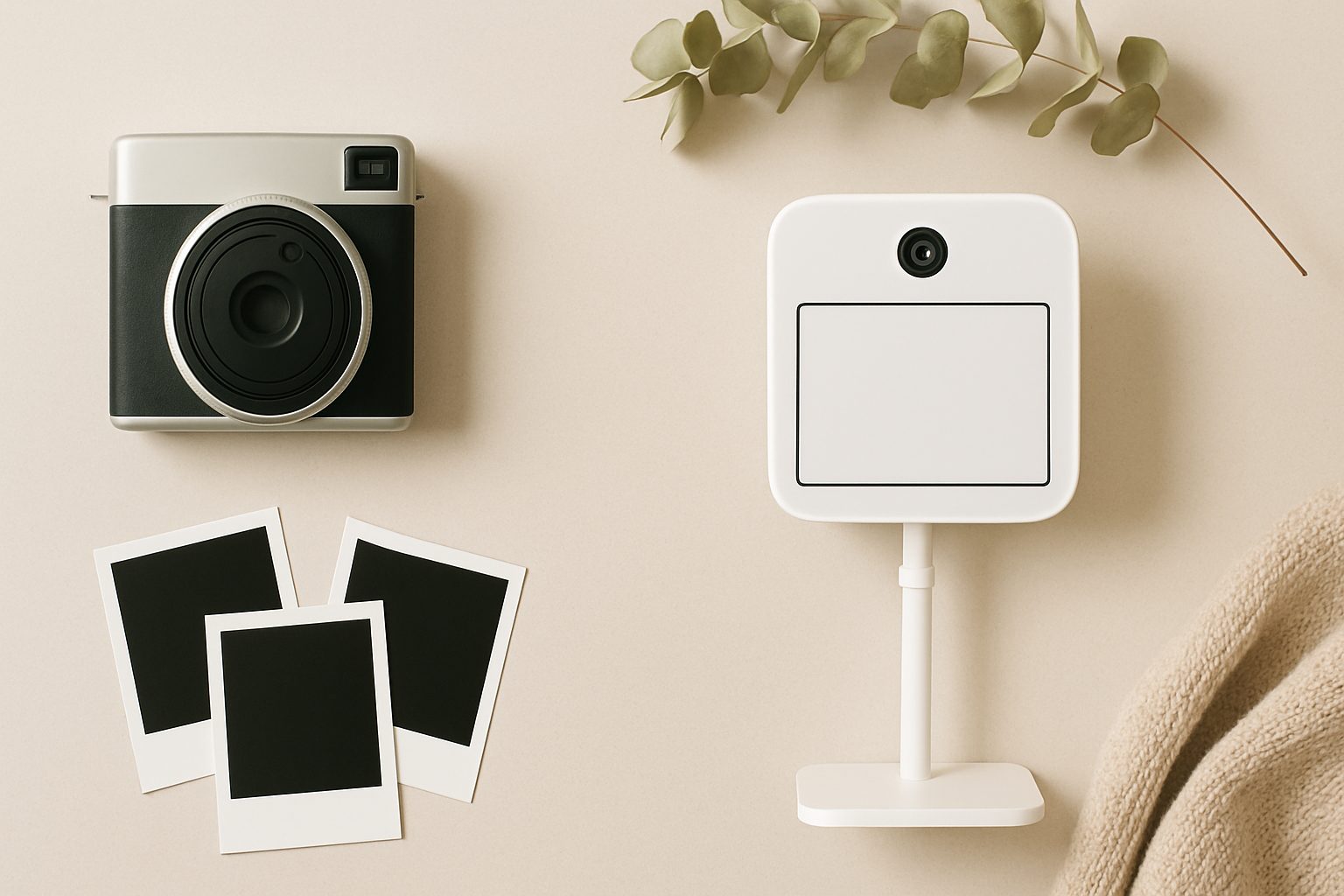
Best Portable Photo Booths for Small Spaces UK — Compact Picks Tested
Running a photo booth business from a flat or terraced house sounds appealing until you realise enclosed photo booths need 3.5 square metres of floor space minimum, plus ceiling height to spare. Most UK homes simply don't have it, and renting additional space defeats the financial purpose.
The solution isn't to squeeze an oversized booth into your spare room. Instead, you pivot toward setups that work with your constraints: ring-light rigs and open-air backdrops. These aren't compromises—they're actually better for intimate events like house parties, small weddings, and garden gatherings where your customers want photos that feel personal, not cramped.
Why Enclosed Photo Booths Don't Work for Small Spaces
Traditional photo booth cabins are black boxes roughly 0.9m × 0.9m inside, with rigid metal frames and motorised curtains. They're designed for venues with dedicated event space: nightclubs, weddings held at large halls, corporate conferences. A single unit weighs 150–300kg, requires 1.5–2kW of power, and needs a ceiling at least 2.4m high.
In a three-bedroom semi, your lounge is probably 4m × 5m. A booth takes up a corner, blocks movement, and looks incongruous against your living room furniture. You can't double the space by offering it in your garden—UK weather, ground conditions, and light variability make this unreliable. More importantly, enclosed booths position you as a generic service, competing on price with established hire companies already running them from dedicated units. Flats have none of the space luxury, making this approach unviable entirely.
The pivot works better commercially: you're not competing with the big operators. You're offering a bespoke, tailored service that only works in intimate settings.
Ring-Light Photo Booth Setups
A ring-light rig is a tripod-mounted LED light ring (usually 40–65cm diameter), a phone holder or camera mount, and a simple backdrop. The entire setup packs into a single bag, transforms any space in under five minutes, and produces genuinely professional results for candid, portrait-style photography.
Ring lights are forgiving. They eliminate harsh shadows, flatter skin tones, and work indoors under any ceiling height. You can position the rig in a living room corner, hallway, or bedroom without structural considerations. Guests stand directly in front, take a photo or short video, and get the file immediately or within hours. The intimacy suits smaller gatherings—10–30 people—where formal poses feel awkward anyway.
Pros:
- Compact and portable: fits in a car boot alongside a backdrop stand
- Minimal power draw: one mains socket, or battery-powered option
- Works in any light condition; you control the quality
- Fast setup and breakdown
- High perceived value for candid, modern-looking photos
Cons:
- Smaller footprint means queuing, though your guests probably prefer the interactive experience
- Requires your active involvement per shot (or a simple selfie mode)
- Less "novelty spectacle" than a closed cabin, though this appeals to most small gatherings
Expect to invest £200–600 for a decent ring light (brands like Neewer or Andoer offer reliable units), plus a backdrop stand (£30–80) and some simple curtain fabric or banner backdrop (£15–50). Total: under £800 for a complete rig.
Open-Air Booth Configurations
Open-air means a backdrop frame—essentially a stand holding fabric, card, or vinyl—with ambient or directional lighting, usually outdoors or in a conservatory. No enclosure, no special lighting other than what your setup provides.
This works brilliantly for UK gardens, especially if you have a patio or decking area. You control the backdrop aesthetic entirely, changing it between events. Guests feel more relaxed, and you can accommodate larger groups without the booth becoming a bottleneck. The setup is truly minimal: a backdrop stand (£40–100), some quality backdrop material (plain colours or branded designs cost £20–150), and decent portable lighting (LED panels run £100–300 per unit).
The catch is weather dependency. British summer weather is unreliable; even in July, a cloudy afternoon kills the soft natural light that makes outdoor photos flattering. You're not at the mercy of it entirely—supplementary LED panels help—but you need a contingency plan.
Pros:
- Lowest barrier to entry; genuinely portable
- Fully customisable aesthetic
- Large capacity: multiple guests at once
- Garden parties and summer gatherings feel enhanced
Cons:
- Weather-dependent quality and reliability
- Requires managed guest flow if you're operating the camera
- Less "defined" than a booth; some customers expect more formal structure
Key Considerations Before Buying
Permissions: Check your tenancy agreement or lease. Most landlords accept temporary setups for event purposes, but installing anything permanent is unlikely. Ring-light rigs are fine; backdrop stands are fine. Don't drill walls.
Electricity: Ring lights need a single socket. LED panels and additional equipment can add up; a small power strip or extension lead is essential. Don't overload circuits.
Weather and seasonality: If you're outdoor-focused, expect most bookings May–September. Diversify by promoting indoor open-air setups—conservatories, covered patios, garages—for off-season events.
Camera or phone? A decent smartphone produces publication-ready photos today. If you invest further, a mirrorless camera (£600–1200) and quality lens gives you genuine advantage, but the learning curve matters.
What to Actually Invest In
Start with a ring-light rig (£300–400 all-in) and test it at friends' gatherings. If demand emerges, add a second backdrop stand and some LED panels for flexibility. Only then consider a camera upgrade if clients are explicitly asking for it.
Avoid buying a second-hand enclosed booth to "test the market." It won't test anything meaningful given your space constraints, and you'll lose money reselling it. The equipment that works for small properties is genuinely what you'll use long-term.
More options
- Portable Instant Photo Booth Printer (e.g. Canon Selphy CP1500 / DNP DS-RX1HS) (Amazon UK)
- Selfie Mirror Magic Mirror Photo Booth Machine (Amazon UK)
- Ring Light with Stand for Photo Booth (18-inch, heavy-duty) (Amazon UK)
- iPad Kiosk Stand Photo Booth Enclosure (Amazon UK)
- Photo Booth Props Kit & Backdrop Bundle (Amazon UK)